
A backyard building that makes its own power
Heavy posts and beams with solar panels for the roof. It charges the car, helps run the hot tub and keeps the essentials on in an outage, with no hookup to the power company.
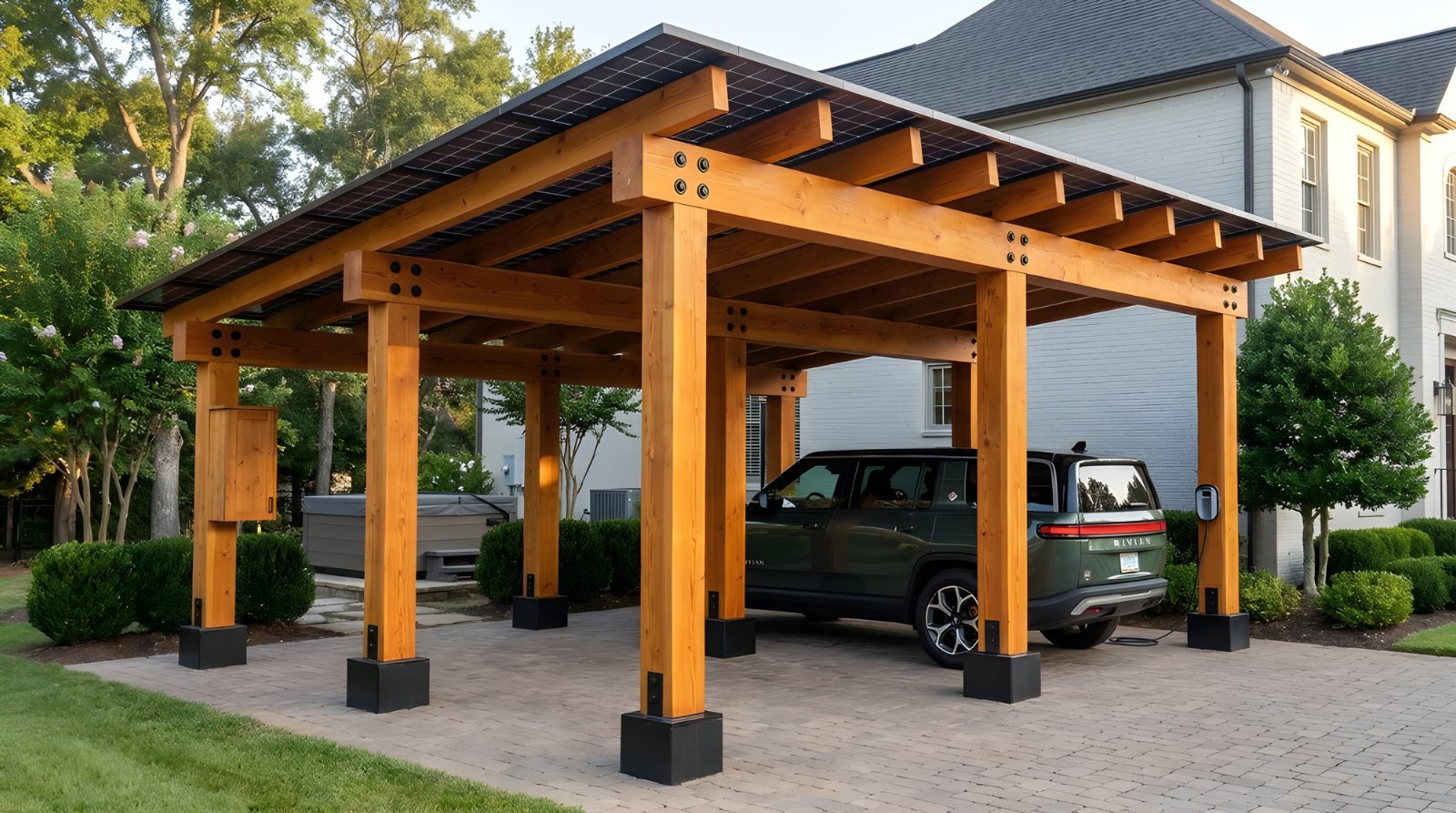
The carport
- Two cars, 22.5 ft wide by about 22.7 ft deep, on six posts
- 24 solar panels for the roof, 10.6 kW
- About 40 kWh a day, averaged over the year in North Carolina, roughly 120 miles of driving on a sunny day
- A car charger on the back post
- Two batteries, about 10 kWh, in a cabinet at standing height
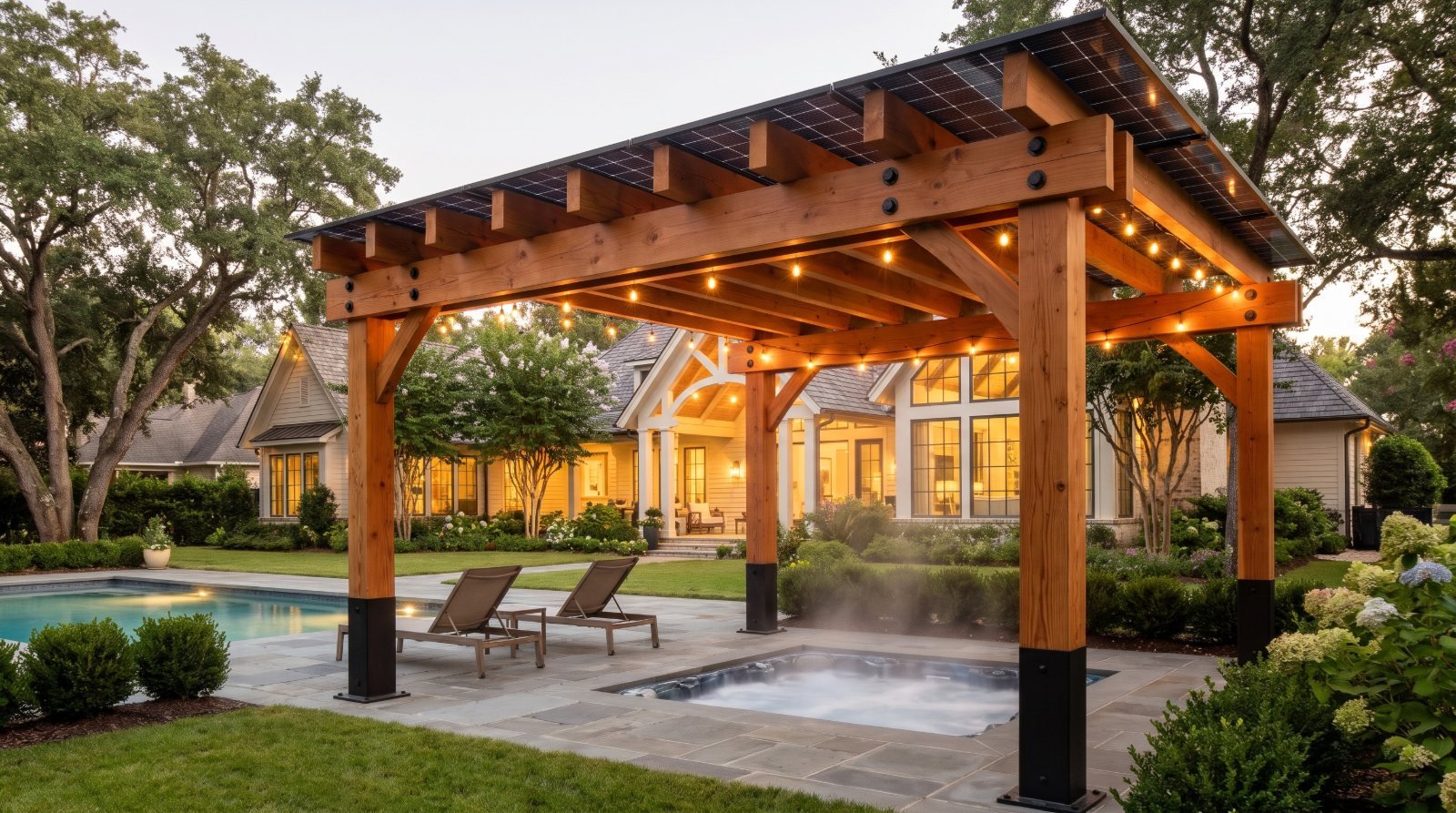
The pavilion
- A gable roof 18.75 ft long over a 16 by 16 ft floor, on six posts
- 20 solar panels for the roof, 8.8 kW
- About 31 kWh a day, averaged over the year in North Carolina
- Room for a hot tub under the roof, or set it beside the pool
- Two batteries, about 10 kWh, in a cabinet at standing height
Post and beam, bolted
- 8 by 8 posts on raised steel bases and concrete footings, so the wood never sits in water.
- Each beam is a pair of 4 by 10 timbers, one on each side of the posts, with four bolts through all three. Straight braces, bolted on. No notches, no pegs, no fancy joinery.
- Rafters spaced so every panel seam lands on a timber.
- The panels are the only roof. A gasket in each seam, a drip channel on each rafter and a gutter on the low side keep it dry underneath.
- The wiring runs inside one post. The inverter and batteries sit in a cabinet clad in the same timber.
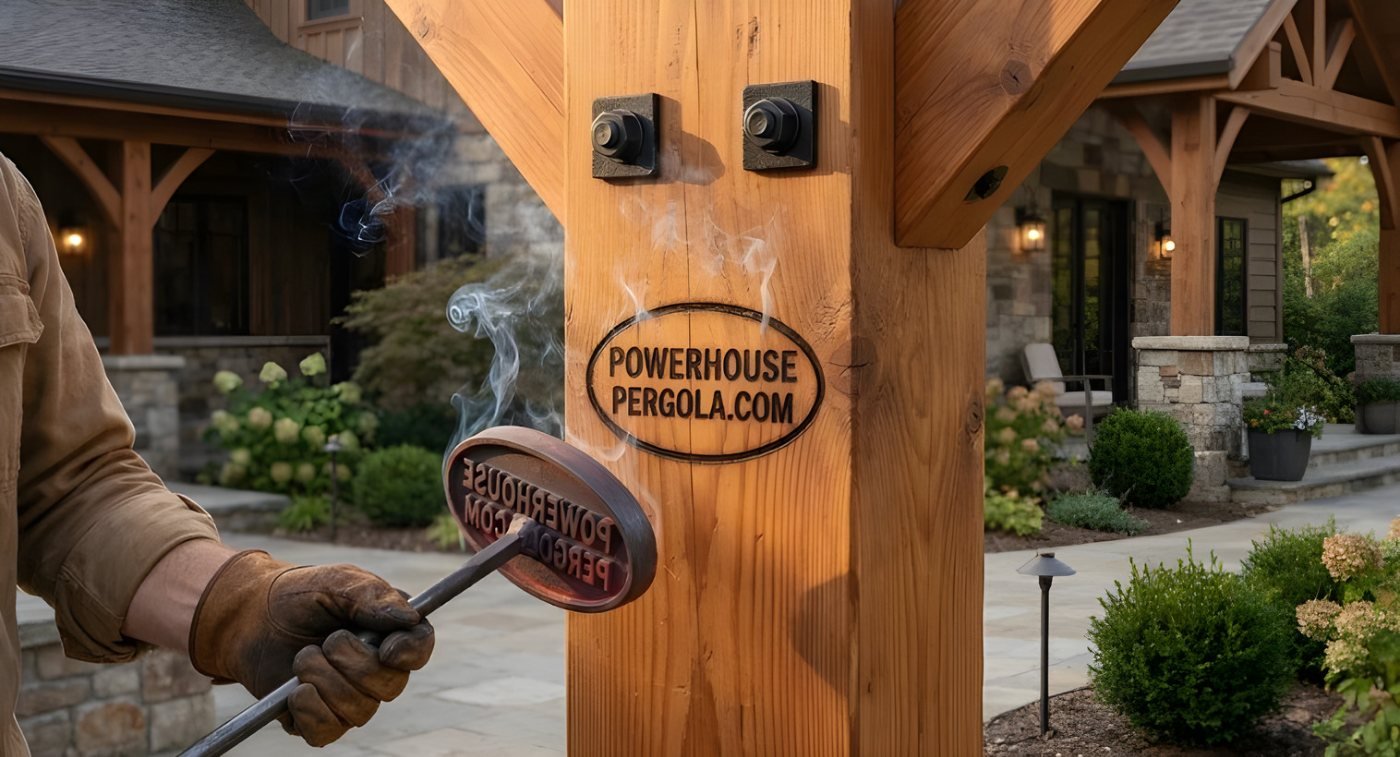
- powerhousepergola.com is burned into a post on every one.
From day one, and later
| From the first day | With a cord or buried cable to the house |
|---|---|
| The car. A hot tub. A pool pump. Lights, fans and outlets under the roof. | The refrigerator, freezer, well pump, furnace and lights in the house, through the same kind of inlet a portable generator uses. |
It never sends power to the grid, so there is no net metering, no interconnection agreement and no waiting on the power company. The inlet at the house still gets an electrical permit and an inspection, like any generator hookup.
About 10 kWh of battery carries a refrigerator, the fan on a gas furnace, the internet and some lights through a night. It is not whole-house backup. On a gray week, a small generator or a plug-in charger tops up the batteries.
What is in the price
Every line of the carport, the way we budgeted it. The lines come to $36,530, and the $38,000 target holds $1,470 in reserve for whatever the first build turns up. The pavilion is built from the same lines and comes to $35,580, with $1,920 in reserve under its $37,500 target. The engineer’s stamp and the permit fees are in the price.
| The carport | Budget |
|---|---|
| 24 solar panels | $3,600 |
| Seam gasket, drip channels and gutter | $2,000 |
| Timber and hardware | $8,000 |
| Footings | $2,800 |
| Inverter and two batteries | $3,880 |
| Wiring, cabinet and outlets | $2,000 |
| Car charger | $450 |
| Labor, craftsman and electrician | $11,500 |
| Engineer’s stamp and permits | $2,300 |
| Total | $36,530 |
Panels, inverter, batteries and charger are listed prices. Timber, footings, labor and engineering are our estimates until a craftsman prices the first one. These numbers assume inland wind; a coastal build needs the engineer’s numbers first.
Not in the price: the hot tub itself, a generator, the cord or buried cable to the house, unusual site work, and anything your HOA asks for.
The craftsman, the electrician and you
| Craftsman | Licensed electrician | You |
|---|---|---|
| Footings, the frame, the panel roof and the cabinet | Connects the panels, inverter and batteries, the outlets, the car charger and the inlet to the house | Choose the spot, hire the electrician, and plug things in |
In North Carolina a job under $40,000 does not need a general contractor license, and both buildings are priced to stay under it. The job needs a building permit and an electrical permit from your county. Approval depends on your county, setbacks, flood zone and HOA, so we look at those before anyone pours a footing.
Where things stand: both designs are drawn and priced line by line. None has been built yet; the first ones are planned for eastern North Carolina.
Who it is not for
- If you want cheap shade, a metal kit from a home store costs a fraction of this.
- If you want the whole house, central air included, running for days on end, a large standby generator does that job better.
- If your yard is in deep shade, the roof won’t make enough power to be worth it.
It is for someone who wants a handsome building in the yard that also makes its own power, quietly, and keeps the essentials going when the lines go down.
Straight answers
Why under $40,000?
In North Carolina a job under $40,000 does not need a general contractor license. Both buildings are priced to stay under that line, so a skilled local craftsman can build them.
Does it hook up to the power company?
No. It runs on its own from the first day, so there is no application to the power company and no waiting on them. If you want it to help run the house, a cord or a buried cable goes to the same kind of inlet a portable generator uses.
What happens on a run of gray days?
The batteries carry the evening and the night. For a gray week, a small generator or a plug-in charger tops them up.
Are these prices final?
No. The panels, inverter, batteries and charger are listed prices. The timber, footings, labor and engineering are our estimates until a craftsman prices the first one. A coastal build needs the engineer’s wind numbers first.
Can I add a fireplace?
Yes, later, by hiring a mason yourself. With a fireplace built in from the start, the job goes over $40,000 and needs a licensed general contractor.
Tell us about your place
Say which one and where. We’ll write back with what fits your yard, what your county will ask for, and when we could build it.