The generator’s
day off
Solar panels in the yard, for the battery you already own.
Day eight. The sky clears, the yard dries out, and the generator does not start. By noon the battery is full.
This page is for a house that already has a battery. Once you own the battery, you already own the expensive half of a solar system. What is left is the cheap half: panels, a rack and wire.
Ten panels on a rack in the yard make about what the refrigerator, well pump, lights and one cool bedroom use on an average day.
- After a storm: on a sunny day the panels refill the battery and the generator takes the day off. The propane tank stops being a countdown.
- Every other day: the panels run the house and top off the battery for the evening.
Why the yard and not the roof
- No holes in the roof, and nothing to take down when the roof is replaced.
- It faces south at the right tilt, whatever way the house faces.
- The salt rinses off with a garden hose.
- More panels can be added later.
What it takes
- Open ground that gets sun most of the day.
- A rack built for hurricane wind.
- Everything kept above flood level.
- A trench from the rack to the house.
The straight numbers
- Price: roughly $4,000 to $7,000 added to a battery you already own. That is a planning estimate, not a quote.
- Savings: about $450 to $700 a year, depending on the power company.
- Pays for itself in: 6 to 15 years.
That is slower than the rush-hour tune-up. It is faster than a generator, which never pays anything back.
The numbers
- Ten panels is about 4 kW. In North Carolina that makes around 5,600 kWh a year, or about 15 kWh on an average day.
- Built by a solar company as a full system, a ground rack runs roughly 30 to 50 cents a watt more than a roof.
- Savings assume all the power is used at home: about 8 cents a kWh on Tideland’s rush-hour plan, about 13 cents on a standard rate.
Two things most solar pages skip
- Bought by itself from a solar company, a rack in the yard costs more than panels on a roof, not less. The posts and the trench add to the bill. It makes sense here because the battery is already paid for.
- Most power companies on this coast pay little for solar sent back to them. This setup uses every bit at home.
Want it to look like something?
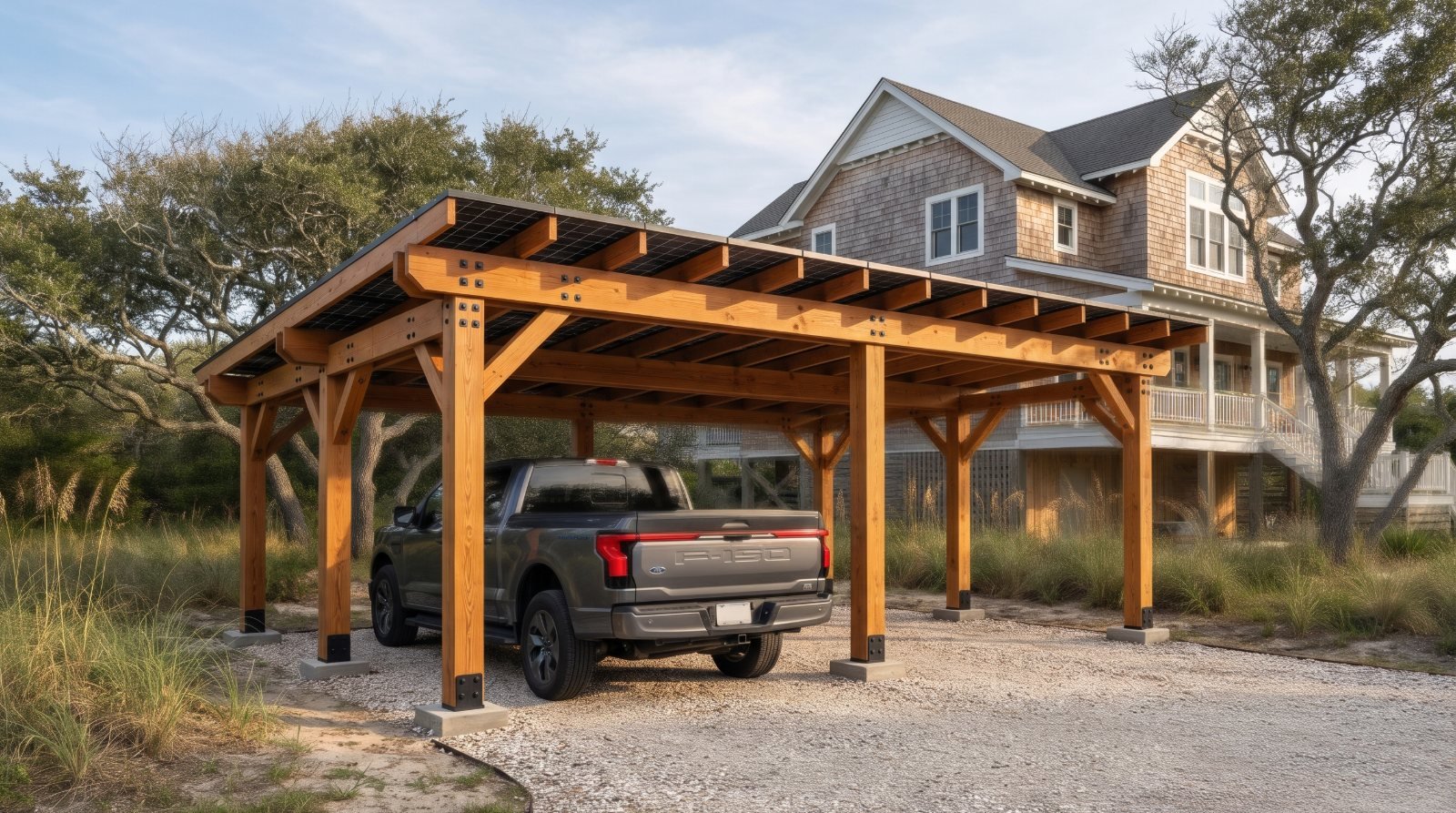
The same panels can be the roof of a post and beam carport or a pool house, with the battery underneath.
For your electrician
- Array wired to the battery inverter’s solar input. No export to the grid.
- Racking and foundation engineered for the site’s design wind speed and soil.
- Conductors sized for the trench length.
- Rapid shutdown and labeling per the adopted code.
Straight answers
Is ground-mount solar cheaper than rooftop solar?
No. Built as a full system by a solar company, a rack in the yard usually runs 30 to 50 cents a watt more than a roof, because of the posts and the trench. It gets cheap when the battery and inverter are already there and only panels, a rack and wire are added.
How many solar panels does it take to run the essentials?
About ten. Ten panels is roughly 4 kW, which in North Carolina makes about 15 kWh on an average day. That is about what a refrigerator, well pump, lights and one cooled bedroom use.
Do solar panels work when the power is out?
Only with a battery. Panels wired straight to the grid shut off when the grid does. Panels wired to a battery keep refilling it.
How long does it take to pay for itself?
About 6 to 15 years on bill savings, by our estimate, for $4,000 to $7,000 of panels and rack added to a battery you already own.